EventsDF
Find Tech events that matter.
Event Management Web
Full Build
Find Tech events that matter.
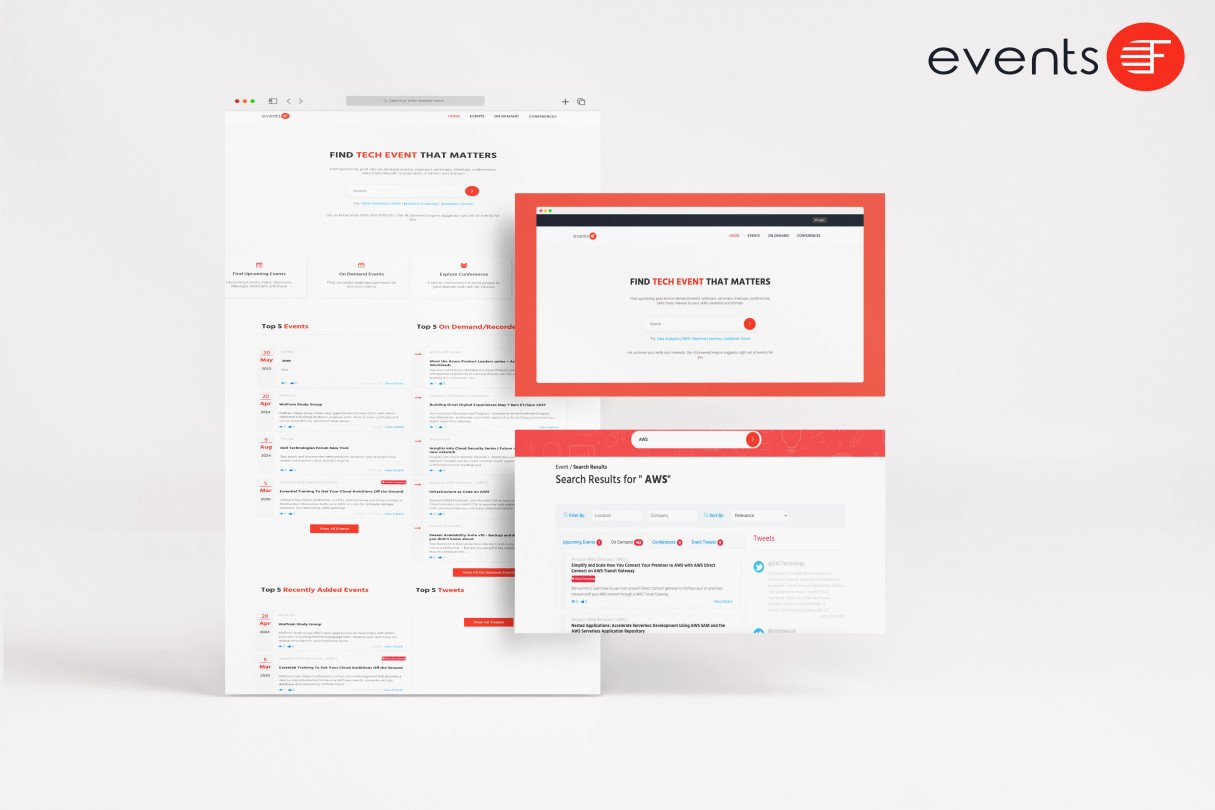
EventsDF is a platform that brings across all the tech events including,
The platform curates a large chunk of data of tech events happening all around the world into a presentable way and personalizes it for every user with their interest level and skills.
The platform’s feed recommends top events both upcoming and recorded. Along with the events, it also collects relevant tweets and presents itself in the positioning of a curated and socially integrated platform for all events.
The user of the platform can also search with relevant keywords to search the specific type of events, that they are looking for.
We started the project at the MVP stage.
The founder, Rakesh Ranjan, who is a YC’18 graduate and an IT industry veteran, was already pursuing an MVP approach and the set of requirements he, had to develop were fitting the exact testing grounds.
The key features identified within the platform was to,
We evaluated the project and chose to use the tech stack of,
Interestingly due to time constraints and other business decisions, we decided to opt for SQL-Full-Text-Search which would later change to a dedicated search engine.
The full-text search presented us with an issue due to limitations in the ORM of MySQL. We overcame the issue by customizing the query to match the relevancy at the same time maintaining the speed needed to handle the large chunks of data.
Since the owner was already following the MVP approach, he had most of the UI designs already prepared.
We worked for 2 phases with the client and after getting a stable second phase, the client opted to further the development in his personal capacity.
TheCodeWork and its team handed over the project and supported the client extensively during its transition.
Architecture-first design with clear separation of concerns, scalable data models, and secure integration points. Built for reliability and future extension.
Delivered on time with a stable, production-ready system. The platform supports ongoing iteration and scale as business needs evolve.
We deliver production-grade platforms with architecture-first thinking and AI-accelerated engineering.