Undoubtedly, enterprise AI is bringing a pivotal force in enhancing operational efficiency and ensuring equipment reliability. Among its various applications, predictive maintenance is particularly noteworthy as a transformative solution for businesses across all sectors. So, by leveraging enterprise AI solutions, businesses can:
- Prevent unforeseen equipment failures
- Optimize maintenance schedules
- Maximize operational productivity
With the global predictive maintenance market expected to reach $23.5 billion by 2027, this strategy has become a critical requirement for forward-looking enterprises. At TheCodeWork®, we specialize in developing AI solutions that seamlessly integrate with your systems, revolutionizing maintenance strategies.
Thus, let’s explore how Enterprise AI is reshaping the landscape of predictive maintenance!
The Importance of Predictive Maintenance
As we know, predictive maintenance leverages real-time data, historical trends, and AI-powered algorithms to anticipate equipment failures before they occur. Consequently, this leads to:
- Anticipating Failures: Detecting potential breakdowns early to minimize downtime.
- Optimizing Resources: Aligning maintenance with actual needs to save costs.
- Improving Safety: Addressing risks proactively to ensure workplace security.
- Enhancing Equipment Lifespan: Prolonging the life cycle of critical assets through timely interventions.
Also, explore Impact of Predictive AI Across Industries!
How Enterprise AI Drives Predictive Maintenance?
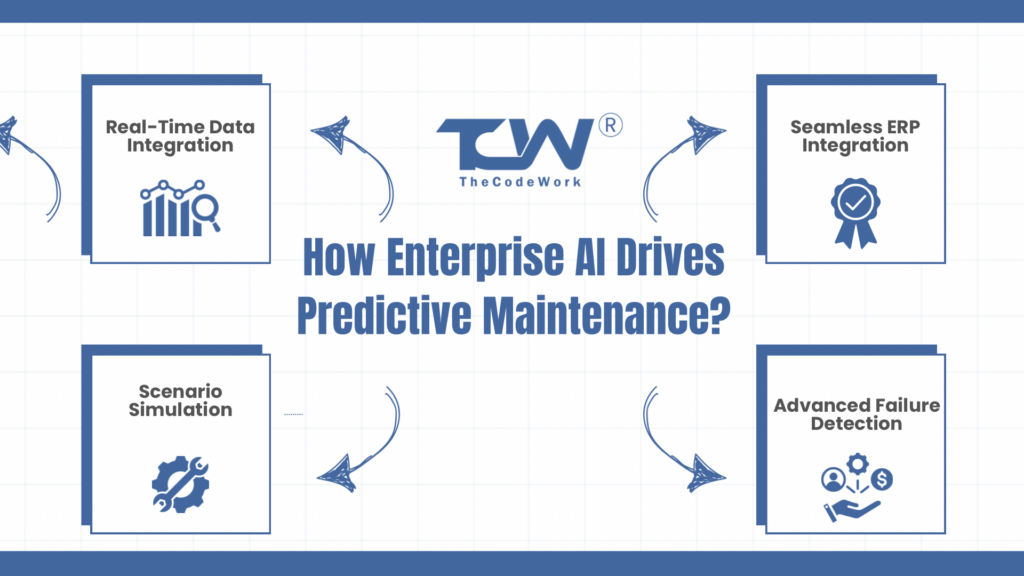
It goes without saying that enterprise AI bridges the gap between raw data and actionable insights. So, here’s how it transforms predictive maintenance into a strategic asset:
1. Real-Time Data Integration
- AI systems collect and process vast datasets from IoT-enabled sensors on equipment.
- Likewise, these sensors monitor key parameters such as temperature, pressure, and vibration.
- Afterwards, continuous data flow ensures maintenance models remain accurate and effective.
Besides, Deloitte states that AI-driven systems improve data accuracy by 25%, leading to better predictive capabilities.
2. Scenario Simulation
- Remarkably, AI allows the simulation of “what-if” scenarios extensively , helping businesses test repair strategies or resource allocation plans. As a result, it reduces risks and enhances decision-making processes.
3. Advanced Failure Detection
- AI-powered algorithms identify patterns and anomalies that indicate potential failures.
- For example, unusual vibration or temperature spikes can signal early-stage issues.
Likewise, McKinsey highlights that predictive maintenance reduces downtime by 30-50% and lowers maintenance costs by 10-40%.
4. Seamless ERP Integration
- AI solutions integrate with ERP dashboards, offering a unified view of equipment health, schedules, and performance metrics.
- Moreover, the centralized approach streamlines operations and boosts efficiency.
Also, checkout TheCodeWork®’s ERP Solutions Across Industries!
Benefits Across Industries
Now, let’s have a look at how predictive maintenance powered by Enterprise AI is making waves in diverse sectors:
- Manufacturing: Reduces unplanned downtime by 45%, ensuring continuous production.
- Energy and Utilities: Improves asset reliability by 30%, enhancing service delivery.
- Logistics & Supply Chain: Lowers unexpected breakdowns by 40%, leading to smoother operations.
- Healthcare: Monitors critical medical equipment, ensuring uptime and patient safety by 60%.
Why Choose TheCodeWork®?
At TheCodeWork®, we specialize in creating customized AI solutions for predictive maintenance. Plus, our expertise guarantees smooth integration with your existing ERP systems, allowing your business to enhance efficiency and mitigate any operational risks.
So, reach out to us today! Book a Free Demo to see our solutions in action!
