Why Supply Chain Digitization Still Fails Despite Technology Investments?
Supply chain digitization has become a major priority for manufacturers and supply chain businesses in India. Companies are investing in ERPs, warehouse management systems, analytics platforms, automation, and AI to improve visibility and efficiency. Yet despite these investments, many supply chains still face stockouts, delayed deliveries, production disruptions, excess inventory, and poor coordination between teams.
So, what is going wrong? The answer is often not a lack of technology. It is the gap between having digital tools and having a digitally connected supply chain.
A company can implement an ERP and still rely on spreadsheets. It can have real-time dashboards and still discover problems too late. It can automate individual processes while the overall supply chain remains fragmented.
This is where many supply chain digitization initiatives fall short.
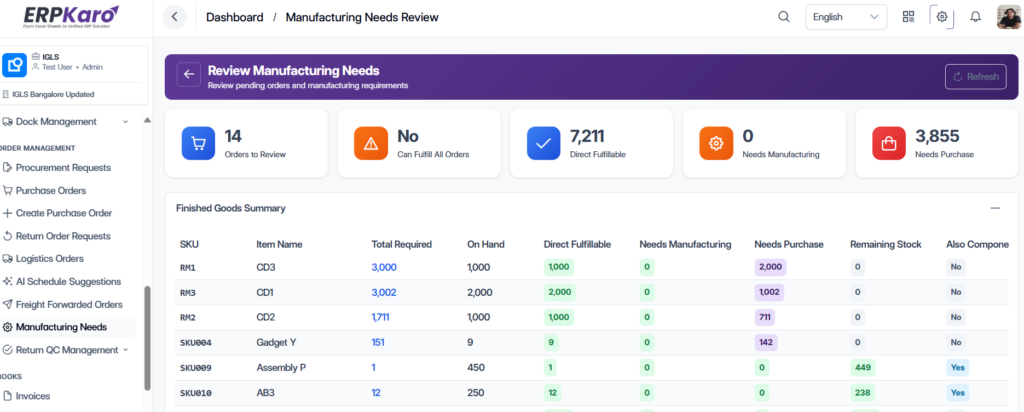
Digitization Does Not Automatically Mean Integration
There is an important difference between digitising individual activities and digitising the supply chain. A procurement team may have procurement software.
- The warehouse may have a WMS.
- Finance may use an ERP.
- Sales may use a CRM.
- Logistics may use a transportation platform.
- Management may have a BI dashboard.
Every department is technically “digital.”
But if these systems don’t communicate properly, the supply chain can still behave like a collection of disconnected functions.
Consider a simple scenario.
- A customer places an order.
- Sales records it in the CRM.
- Production doesn’t immediately see the requirement.
- Procurement discovers later that a critical raw material is running low.
- The purchase order is raised late.
- The supplier delivers after the planned production date.
- The production schedule changes.
- Dispatch gets delayed.
The customer asks why the order is late.
Every department may have used a digital system.
The supply chain still failed.
This is why effective supply chain digitization is not simply about adding more software. It is about creating connected operational intelligence across the business.
1. Your Systems Are Connected, But Your Data Isn’t
One of the most common problems in supply chain digitization is having multiple systems without a reliable flow of information between them.
- Data gets copied from one system to another.
- Excel files are uploaded manually.
- Teams export reports and email them to other departments.
- Employees maintain their own versions of inventory or supplier data.
Someone eventually reconciles everything.
This creates what is effectively a digital version of the old manual supply chain.
The files may be digital.
The dashboards may look modern. But the underlying workflow remains fragmented. A connected ERP environment should allow information to move naturally across functions.
- A sales order should influence production planning.
- Production requirements should influence procurement.
- Procurement should influence inventory expectations.
- Inventory availability should influence fulfilment.
- Dispatch should update order status.
- Finance should have visibility into the commercial impact.
The objective is not simply to store information digitally. It is to ensure that one operational event creates the right downstream actions.
2. Your ERP Records Problems Instead of Preventing Them
ERP systems are extremely useful for creating a central source of operational data. But implementing an ERP does not automatically improve decision-making.
A common mistake is treating ERP as a sophisticated record-keeping system.
The company enters:
- Purchase orders
- Sales orders
- Inventory movements
- Production records
- Supplier information
- Dispatch details
But the system isn’t configured to help teams act on this information.
For example, an ERP may tell you: Raw material stock: 1,200 units.
That’s useful.
But what the procurement manager really needs to know is:
- Current stock: 1,200 units
- Average weekly consumption: 450 units
- Open production requirements: 1,000 units
- Supplier lead time: 14 days
- Projected shortage: 9 days from now
That is a completely different level of visibility. The first tells you what exists. The second helps you decide what to do.
This is where modern ERP systems are increasingly moving towards analytics, forecasting and AI-assisted decision-making.
3. People Are Still the Integration Layer
If your teams need to constantly call, message, or email each other to understand what is happening, your systems aren’t fully integrated. This is especially common in manufacturing.
A production manager asks procurement: “Has the material arrived?”
- Procurement calls the supplier.
- The supplier says it will arrive tomorrow.
- Procurement updates production.
- Production adjusts the schedule.
- Sales is then informed that the order may be delayed.
At every step, humans are acting as the middleware between systems. People will always need to make decisions.
They shouldn’t have to spend their time moving information between departments.
Good supply chain digitization reduces this dependency.
- The system should surface the information.
- The right people should receive the relevant alert.
- The workflow should trigger the next action.
- The decision should remain with the person responsible.
Automation should remove coordination friction, not remove human judgement.
4. Your Data Is Digital, But Your Processes Are Still Manual
Moving a paper form into an ERP doesn’t necessarily make the process intelligent. For example, suppose a warehouse employee previously maintained stock in a register.
Now the employee enters the same information into an ERP. The record is digital.
But the process may still involve:
- Receiving the material
- Writing down the quantity
- Checking another document
- Entering the information later
- Waiting for someone to approve it
- Updating another spreadsheet
- Informing procurement manually
The technology has changed. The process hasn’t.
This is why successful supply chain digitization needs process redesign, not just software implementation.
Before implementing technology, businesses should ask:
- What information is being captured?
- Who needs it next?
- What decision depends on it?
- What can happen automatically?
- Where is human approval actually necessary?
These questions often reveal that the biggest opportunity isn’t another software feature. It is removing unnecessary steps from the workflow.
5. Dashboards Give You Visibility, Not Control
Dashboards are useful. But there is a difference between seeing a problem and being able to respond to it quickly. Imagine a dashboard showing that inventory has fallen below its minimum level. That’s visibility.
But what happens next?
- Does the procurement manager receive an alert?
- Does the system check open purchase orders?
- Does it consider upcoming production requirements?
- Does it identify the preferred supplier?
- Does it calculate the potential shortage?
- Does someone have to export the data into Excel before making a decision?
If the answer is yes, the dashboard is functioning as a reporting tool rather than an operational system.
The goal should be to move from:
Data → Dashboard → Human interpretation → Action
towards:
Data → Insight → Recommended action → Human decision → Execution
That is where analytics and AI can make ERP systems significantly more useful.
6. Technology Cannot Fix Poor Master Data
There is another uncomfortable truth: AI cannot compensate for bad operational data.
If product codes are inconsistent, supplier information is outdated, BOMs are incorrect and inventory records are unreliable, adding an AI layer won’t magically solve the problem.
In fact, it can make the problem harder to identify.
Effective supply chain digitization needs reliable foundational data:
- Accurate product and SKU information
- Correct BOMs
- Current supplier records
- Reliable inventory quantities
- Consistent units of measurement
- Accurate lead times
- Historical transaction data
- Clearly defined workflows
This is one reason ERP implementation should not be treated as an IT project alone. It is an operational transformation project.
The software is only as useful as the processes and data supporting it.
7. Your Supply Chain Is Optimised Department by Department
Another common problem is local optimisation.
- Procurement wants to buy in bulk because it gets a better price.
- Finance wants to minimise working capital.
- The warehouse wants fewer SKUs occupying space.
- Production wants sufficient material available.
- Sales wants finished goods immediately.
- Logistics wants full truckloads.
Every department may be achieving its individual KPI. The supply chain can still perform badly.
For example, procurement might save 5% through bulk purchasing while creating six months of excess inventory.
From procurement’s perspective, that’s a success.
From the business’s perspective, capital is sitting idle. A connected ERP can help management look beyond departmental metrics and understand the relationship between decisions.
The question becomes:
“What is the best decision for the supply chain?”
rather than:
“What is the best decision for my department?”
That is a much more powerful way to approach supply chain digitization.
What Effective Supply Chain Digitization Should Look Like
A resilient digital supply chain doesn’t necessarily require dozens of applications.
It requires the right information to reach the right person at the right time.
At a practical level, that means connecting:
Demand → Orders → Inventory → Procurement → Production → Warehouse → Dispatch → Finance
The important part is the flow between these functions.
For example:
A new customer order enters the system.
↓
Inventory is checked.
↓
Available stock is allocated.
↓
Material requirements are calculated.
↓
Procurement requirements are identified.
↓
Production capacity is checked.
↓
A production plan is created.
↓
Warehouse and dispatch requirements are updated.
↓
Management can see the expected fulfilment status.
Now imagine adding analytics.
The system can identify that the order may be at risk because a supplier has historically delivered late.
Add AI.
The system can potentially recommend alternative purchasing or scheduling actions based on historical patterns and current constraints.
This is where supply chain digitization starts becoming genuinely transformative.
Where ERP Fits Into Supply Chain Digitization?
ERP remains the foundation for a connected supply chain. It provides the transactional backbone that brings business functions together.
But the ERP needs to be designed around the company’s actual workflows. For manufacturing and supply chain businesses, this typically means connecting areas such as:
- Sales and order management
- Inventory and warehouse operations
- Procurement
- Production planning
- BOM management
- Supplier management
- Dispatch and logistics
- Billing and invoicing
- Reporting and analytics
The objective isn’t to implement an ERP because “every business needs an ERP.”
The objective is to create a single operational picture of the business.
That is particularly important for growing manufacturing companies that have outgrown spreadsheets and disconnected applications but don’t necessarily need the complexity of a large enterprise ERP deployment.
How ERPKaro Approaches the Problem?
This is one of the reasons we built ERPKaro.
At TheCodeWork, we repeatedly saw manufacturing businesses struggling with the same underlying problem.
- They had software.
- They had spreadsheets.
- They had experienced teams.
- They had data.
But information was still fragmented across departments. The problem wasn’t always the absence of technology.
It was the absence of a connected operational system built around manufacturing workflows.
ERPKaro is a manufacturing-focused ERP designed to bring core functions such as inventory, procurement, production planning, sales orders, warehouse operations, dispatch and reporting into a connected platform.
The goal is straightforward:
Make operational information available where decisions are actually being made.
Instead of procurement working from one dataset, production from another and management waiting for manually prepared reports, the business can work from a shared operational view.
That matters because supply chain resilience isn’t created by having more software. It is created when people, processes and technology work as one system.
See how ERPKaro can fit into your operations
If your teams are still switching between ERP screens, spreadsheets, WhatsApp messages and disconnected systems to manage day-to-day operations, it may be time to rethink your approach to supply chain digitization.
Explore ERPKaro or speak with our team about your current workflows.
The Real Goal of Supply Chain Digitization
The success of digitization shouldn’t be measured by the number of systems implemented.
It should be measured by what those systems enable the business to do. Ask the following questions:
Can…
- you identify a potential stockout before it stops production?
- procurement see upcoming material requirements?
- production understand which orders are at risk?
- management see the real status of operations without waiting for a spreadsheet?
- teams act on the same information?
- the business respond to disruption without relying on one person who “knows how everything works”?
If the answer is no, your supply chain may be digitized. But it isn’t necessarily digitally connected.
That distinction is becoming increasingly important. The next phase of supply chain digitization isn’t about adding technology for the sake of technology.
It is about connecting the systems you already have, fixing the processes underneath them, improving data quality, and using analytics and AI where they can genuinely improve decisions.
Because a resilient supply chain isn’t one that never breaks. It can see the break coming, respond quickly, and recover without bringing the entire operation to a halt.
Ready to rethink your supply chain?
If your current ERP, spreadsheets, and operational tools still leave your teams chasing information across departments, let’s look at the workflows behind the problem.
Talk to TheCodeWork about your manufacturing and supply chain operations, or see how ERPKaro can help bring them into one connected system.