Product Engineering
How Are AI & Analytics Changing ERP for Manufacturing Companies in India?
ERP for manufacturing has traditionally been about bringing business processes together. Inventory, procurement, production, sales, finance, and reporting could all be managed from one system instead of spreadsheets and disconnected tools. But the role of ERP is changing.
Today, manufacturers need more than a system that records what happened. They need technology that can help them understand why it happened, what is likely to happen next, and what they should do about it. This is where Artificial Intelligence (AI) and analytics are changing the way ERP works.
For Indian manufacturing companies, particularly SMEs and MSMEs, this shift is becoming increasingly relevant. Manufacturing businesses are dealing with fluctuating demand, tighter margins, supply-chain disruptions, rising customer expectations and increasing pressure to make faster decisions.
AI can help turn the data already sitting inside an ERP into something far more useful: actionable intelligence. According to PwC, 54% of Indian manufacturing firms surveyed are showing an upward implementation trend toward analytics and AI.
So what does an AI-enabled ERP actually change for a manufacturer?
From Recording Data to Understanding Data
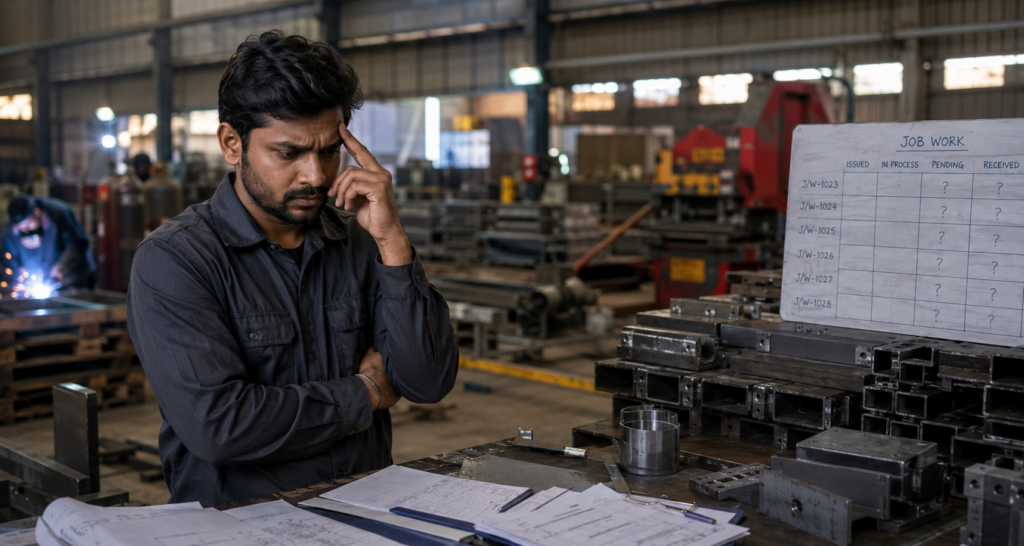
A traditional ERP answers questions such as:
- How much inventory do we have?
- Which orders are pending?
- What did we produce last month?
- Which suppliers have outstanding purchase orders?
- How much did we sell?
These are important questions. But modern manufacturing requires another layer of intelligence.
For example:
Traditional ERP:
“We produced 8,000 units last month.”
Analytics:
“Production was 12% lower than the previous month, primarily because two critical raw materials were unavailable.”
AI-enabled ERP:
“Based on current orders, historical demand and available inventory, production may fall short of next month’s expected demand. Purchasing these materials within the next five days could help avoid a potential shortage.”
That is a fundamental shift.
ERP is moving from being a system of record to becoming a system of intelligence. The objective isn’t to replace factory managers, procurement teams or production planners. It is to give them better information before they make decisions.
1. Smarter Demand Forecasting
Demand forecasting has always been one of the difficult parts of manufacturing. Manufacturers have to consider historical sales, seasonality, customer orders, market trends, product performance and inventory availability.
Traditionally, forecasting may depend heavily on spreadsheets and individual experience. AI changes this by analysing large volumes of historical and operational data to identify patterns that may not be immediately visible.
For example, an AI-enabled ERP could identify:
- Products with consistently increasing demand
- Seasonal changes in order volumes
- Customers whose purchasing patterns are changing
- Products with declining demand
- Demand correlations between different products
- Potential future stock shortages
This doesn’t mean AI will always predict demand perfectly.
It means production and procurement teams can make decisions using data-backed forecasts instead of relying entirely on assumptions or historical averages.
For manufacturers operating with tight inventory margins, that difference can be significant.
2. Better Production Planning
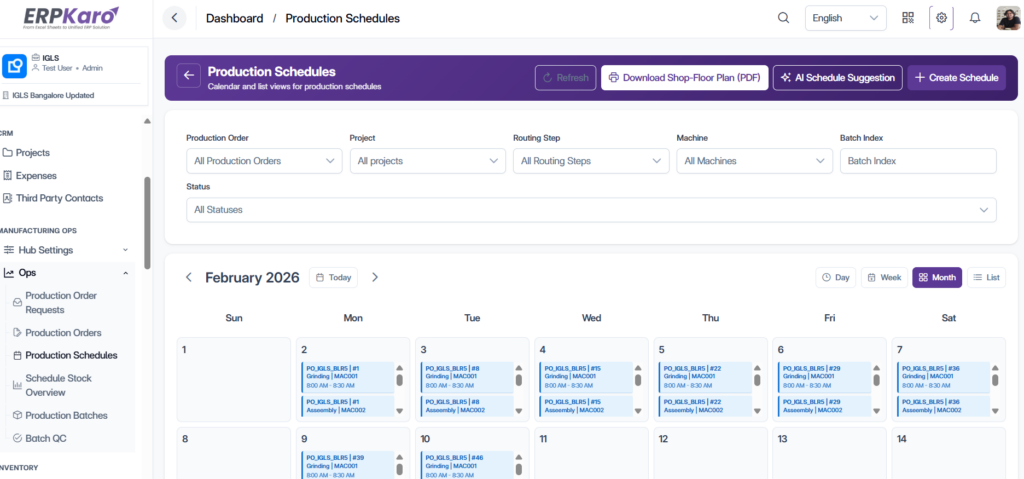
Production planning becomes difficult when demand, inventory, machine availability, manpower, and raw materials are constantly changing.
A production schedule that looks perfect in the morning may need to be changed by the afternoon because a material hasn’t arrived or a customer has changed an order.
AI and analytics can help production teams identify these dependencies earlier.
An intelligent ERP can analyse:
- Current orders
- Available raw materials
- Bill of Materials (BOM)
- Production capacity
- Previous production cycles
- Machine availability
- Delivery commitments
- Historical production performance
The result is a more dynamic approach to production planning.
Instead of asking:
“What should we produce?”
The system can help answer:
“What should we produce, when should we produce it, and what could prevent us from meeting the plan?”
That is much closer to how a modern manufacturing operation needs to work.
3. Predictive Inventory Management
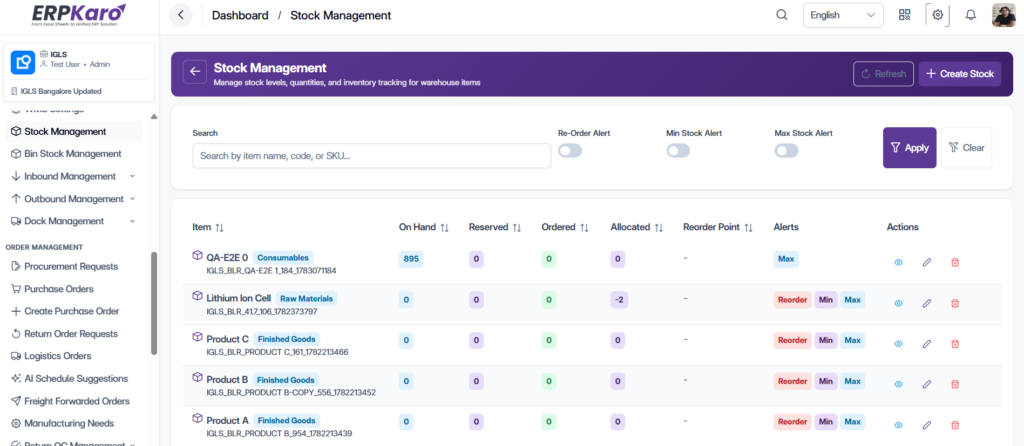
Inventory is one of the biggest areas where manufacturing companies can lose money without immediately noticing it. Too little inventory can stop production. Too much inventory ties up working capital.
The challenge is finding the right balance. Analytics can help manufacturers understand inventory movement across products, materials, suppliers and locations. AI can take this further by identifying patterns and recommending actions.
For example:
“Material X has historically taken 12–15 days to arrive from this supplier. Based on current production requirements, the existing stock may not be sufficient.”
That insight gives the procurement team time to act.
It can also help identify slow-moving inventory, frequently consumed materials, abnormal stock movements and products that may require different stocking strategies.
The goal isn’t simply to maintain more inventory. It is to maintain the right inventory at the right time.
4. Predictive Maintenance
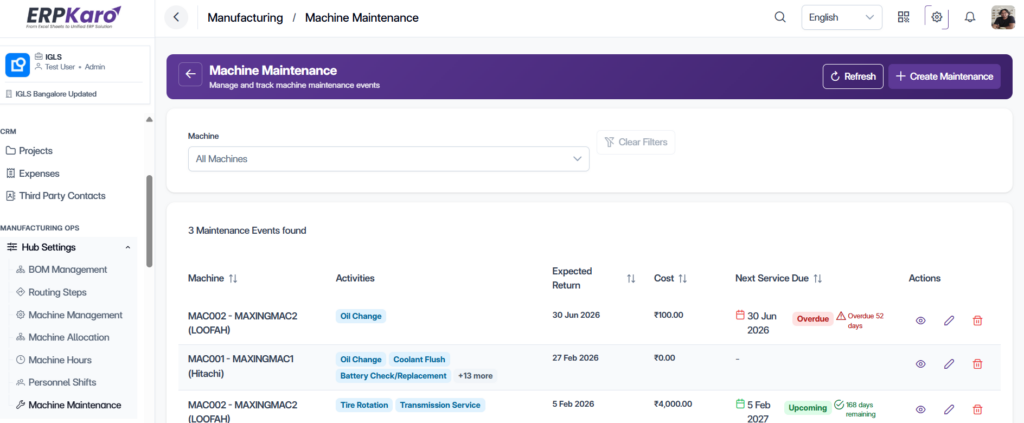
Manufacturing downtime is expensive. A machine failure can affect production schedules, delivery commitments, labour utilisation and customer relationships.
Traditional maintenance often follows a fixed schedule: “Service the machine every three months.”
Predictive maintenance takes a different approach.
By combining machine data, maintenance history, operating conditions and production information, AI can help identify patterns associated with potential equipment failures.
For example:
- Increasing frequency of breakdowns
- Abnormal operating patterns
- Components requiring replacement
- Recurring maintenance issues
- Equipment with declining performance
This allows maintenance teams to move from reactive maintenance to proactive maintenance.
AI is increasingly being positioned as a practical productivity tool for Indian MSMEs, including applications in machine maintenance, quality and shop-floor operations.
5. Real-Time Analytics for Faster Decisions
One of the biggest advantages of modern ERP systems is visibility.
Instead of waiting for someone to consolidate spreadsheets at the end of the day, management can see what is happening across the business. But dashboards alone aren’t enough.
A dashboard might tell you that inventory has increased by 18%. Analytics should help you understand why.
And AI can potentially take this one step further by allowing managers to interact with business data using natural language.
For example:
- “Which products had the highest rejection rate last quarter?”
- “Which suppliers have delayed deliveries most frequently?”
- “What is our current inventory value?”
- “Which orders are at risk of being delayed?”
The future of ERP is therefore not just more dashboards. It is better questions, faster answers and clearer actions.
6. AI-Powered Procurement
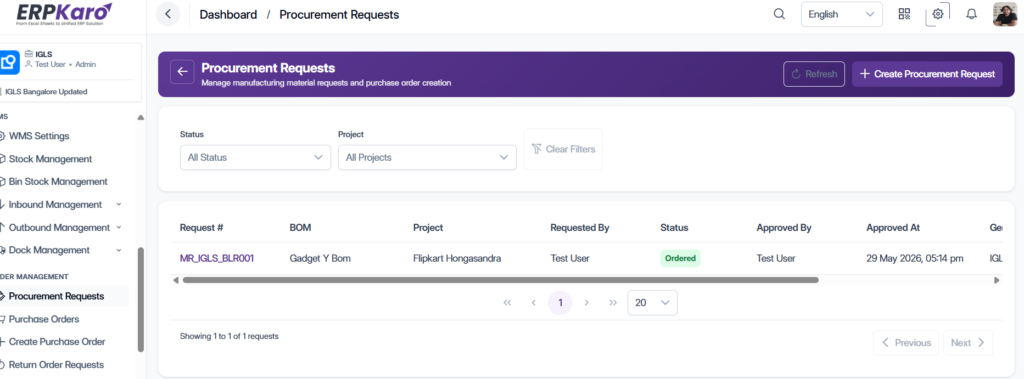
Procurement teams often work with a combination of purchase orders, supplier conversations, spreadsheets, inventory data and production requirements.
This makes it difficult to maintain a complete view of purchasing decisions. AI and analytics can bring these data points together.
An intelligent ERP can help procurement teams identify:
- Materials approaching reorder levels
- Suppliers with repeated delivery delays
- Price changes over time
- Purchase patterns
- Supplier performance
- Upcoming material requirements
- Opportunities for better purchasing decisions
Instead of procurement being driven primarily by urgent requirements, it can become more proactive. This is particularly important for manufacturers where a delay in one component can disrupt an entire production schedule.
7. Connecting Shop-Floor Data with Business Decisions
Perhaps the most important change is the connection between operational data and management decisions. A factory generates enormous amounts of information every day.
- Production quantities.
- Machine utilisation.
- Material consumption.
- Quality issues.
- Rejections.
- Downtime.
- Purchase orders.
- Sales orders.
- Dispatches.
- Inventory movements.
Historically, much of this information remained within individual departments.
AI-enabled ERP systems can bring these data points together. This creates a connected view of the business where management can understand the relationship between different functions.
For example:
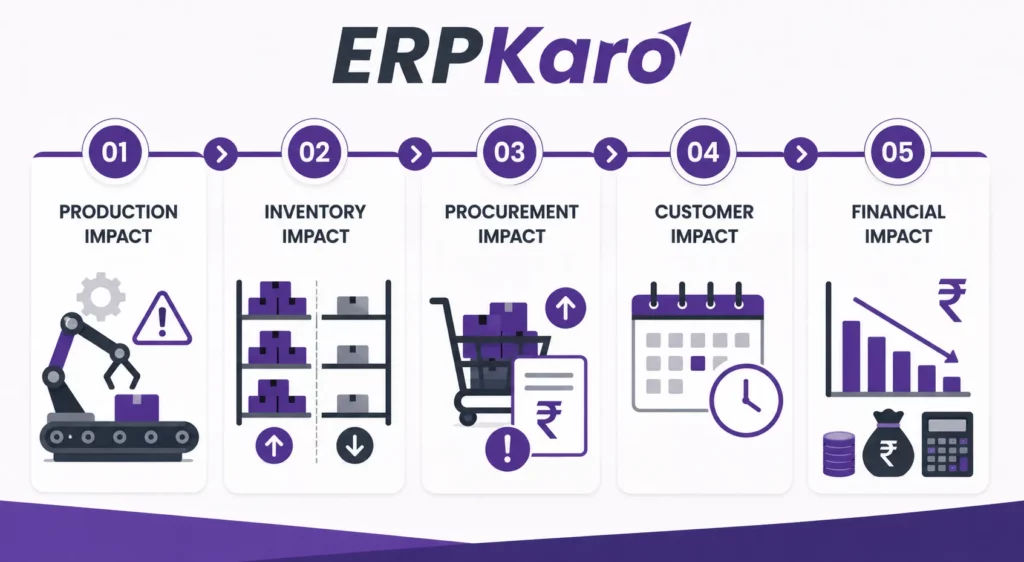
A delayed customer order → shortage of raw material → delayed procurement → production schedule change → dispatch delay.
Instead of seeing five separate problems, management can see one connected operational issue. That is where analytics becomes genuinely valuable.
Why This Matters for Indian Manufacturing SMEs?
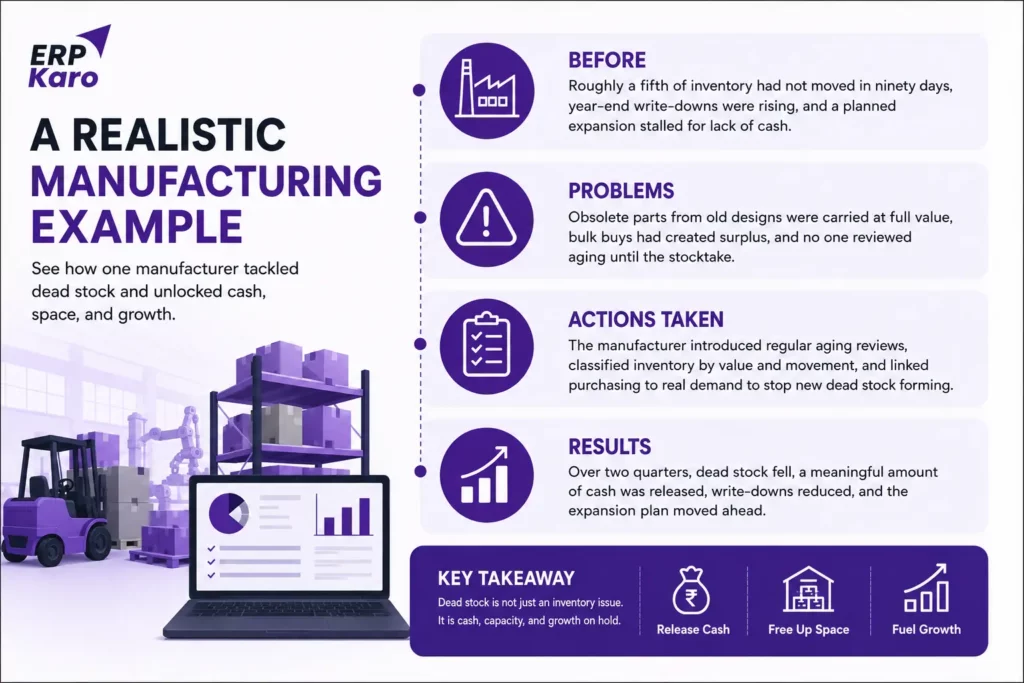
AI in manufacturing is sometimes presented as something reserved for large factories with expensive sensors, robotics and dedicated data science teams.
That is changing.
Indian manufacturing MSMEs are increasingly being viewed as an important part of the country’s AI adoption journey. PwC estimates that manufacturing MSMEs accounted for approximately 35.4% of India’s manufacturing value added in FY23–24 and nearly 48.58% of exports in FY24–25.
The opportunity is not necessarily to implement every possible AI technology at once. For an SME manufacturer, the better approach is to start with practical business problems.
For example:
- Problem: Frequent stockouts
Technology: Demand forecasting + inventory analytics - Problem: Production delays
Technology: Production planning + predictive insights - Problem: Excess inventory
Technology: Inventory analytics + demand prediction - Problem: Frequent machine breakdowns
Technology: Predictive maintenance - Problem: Management spends hours preparing reports
Technology: Real-time dashboards + AI-assisted reporting
The technology should follow the business problem, not the other way around.
What the ERP of the Future Looks Like?
The next generation of ERP will not simply be a collection of modules. It will increasingly become an intelligent layer connecting people, processes and data.
A manufacturing ERP of the future could look something like this: ERP + Analytics + AI + Automation + Real-Time Data
The ERP manages the core workflows.
Analytics explains what is happening.
AI identifies patterns and makes predictions.
Automation executes repetitive tasks.
Real-time data keeps the entire system current.
Together, these capabilities can create a much more responsive manufacturing operation.
This direction is also reflected in India’s broader manufacturing roadmap, which calls for digital visibility platforms using technologies such as IoT and AI for real-time tracking and predictive analytics, alongside open APIs and sector-specific digital solutions.
How ERPKaro Approaches Manufacturing ERP?
At TheCodeWork, our work with manufacturing businesses led us to a simple observation: manufacturers don’t just need another ERP with more modules.
They need a system that understands manufacturing operations.
That thinking led us to build ERPKaro, a manufacturing-focused ERP designed for growing businesses. ERPKaro brings key operations such as inventory, procurement, production planning, orders and reporting into one platform.
The objective is straightforward: Give manufacturers better operational visibility without the complexity traditionally associated with enterprise ERP systems.
And AI and analytics are an important part of where that platform is heading. Because the future of manufacturing ERP isn’t about replacing the people running the factory.
It is about giving those people better information to work with.
Want to see what a manufacturing-focused ERP can look like?
Book an ERPKaro demo and see how a connected ERP can help bring your manufacturing operations, data and decision-making together.
The Road Ahead
Indian manufacturing is entering a more data-driven phase. The competitive advantage will not necessarily belong to the companies collecting the most data.
It will belong to the companies that can turn that data into decisions.
AI and analytics are making that possible by changing what ERP systems can do. The ERP of the past told manufacturers what happened.
The ERP of today helps them understand what is happening. On the other hand, the ERP of tomorrow will increasingly help them anticipate what could happen next.
For Indian manufacturers, especially growing SMEs and MSMEs, that transition does not have to mean a massive technology overhaul.
It can start with something much simpler: Get your operational data connected. Make it visible. Then make it intelligent. That is where the next generation of manufacturing technology begins.
Looking to modernise your manufacturing operations?
Talk to TheCodeWork’s team to explore how AI, analytics and manufacturing ERP can work together for your business.