Visual brief
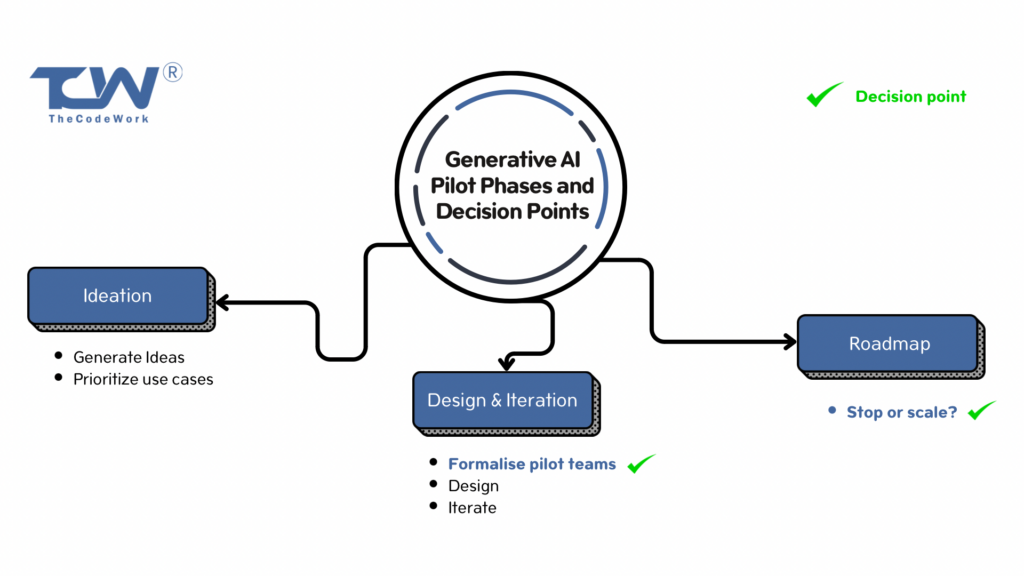
Generative AI Pilot Phases and Decision Points: A Strategic Guide
Generative AI holds immense potential to transform business operations, yet its successful deployment depends on a structured pilot approach.
- Phase 1: Generate Ideas Identify key business areas: Initiate with brainstorming on where AI can provide value, primarily focus on repetitive and data-heavy tasks.
- Phase 5: Iterate (Build, Refine, Test) Build and test prototypes: Start with a prototype to evaluate the model’s performance and functionality.
- Phase 6: Create a Roadmap for Scaling Plan for infrastructure and resources: Finally, assess what needs to be scaled with your AI solution across the organization, like technology and staffing requirements.
In full
Undoubtedly, Generative AI holds immense potential to transform business operations, yet its successful deployment depends on a structured pilot approach. Likewise, with a strategic approach in the early stages, businesses can make the right decisions to maximize impact.
Therefore, here’s a breakdown of the key phases and strategic points to guide you:
Phase 1: Generate Ideas
- Identify key business areas: Initiate with brainstorming on where AI can provide value, primarily focus on repetitive and data-heavy tasks.
- Align with business goals: Ensure that your AI initiatives directly support overarching strategic objectives for maximum impact.
Explore: Discover how our AI-driven solutions can streamline and elevate your business operations.
Phase 2: Prioritize Use Cases
- Evaluate feasibility: Then, assess your ideas based on data availability, resource needs, and expected ROI.
- Focus on high-impact use cases: Afterwards, select projects that align with your strengths and measurable outcomes.
Phase 3: Formalize Pilot Teams
- Assemble a cross-functional team: Include data analyst and scientists, subject matter experts, and AI-Project managers to ensure diverse expertise.
- Define roles and responsibilities: Likewise, set clear expectations to ensure smooth collaboration and accountability across all team members.
Phase 4: Design the Solution
- Understand data and model requirements: Tailor AI models as per your chosen use case,while ensuring compatibility with the available data and technology.
- Address ethical concerns: On the other hand, consider privacy, bias, and compliance check ups during the early phases to mitigate risks.
Related Article: Check out TheCodeWork®’s guide on IT Compliance and Regulations.
Phase 5: Iterate (Build, Refine, Test)
- Build and test prototypes: Start with a prototype to evaluate the model’s performance and functionality.
- Refine based on feedback: Then, continuously test and adjust the model using real-world data and user inputs to improve accuracy and relevance.
- Measure success: Also, define key performance indicators (KPIs) to assess effectiveness and guide refinement.
Phase 6: Create a Roadmap for Scaling
- Plan for infrastructure and resources: Finally, assess what needs to be scaled with your AI solution across the organization, like technology and staffing requirements.
- Develop training and support plans: Ensure that your employees are equipped to work with the new AI tools.
- Establish governance: Lastly, develop a framework for responsible AI use, addressing ethics, data privacy, and continuous oversight.
FAQs
Q1. How much time does a generative AI pilot typically take?
Ans: The duration varies depending on project complexity and resources but it generally takes several weeks to a few months. Subsequently, each phase—ideation, testing, and scaling—requires careful planning and time.
Q2. Is ongoing maintenance required for generative AI systems?
Ans: Yes, ongoing maintenance is essential for performance, ethical standards, and adapting to changes in business needs.
Contact TheCodeWork® today to start your AI transformation journey!