Visual brief
Scaling AI Strategies for AI-Driven Enterprises
Scaling AI strategies is more than just an upgrade! With AI becoming more accessible, modern enterprises are scaling its potential.
- Defining an AI Strategy Aligned with Business Goals It goes without saying that drawing an AI strategy requires more than just technical expertise – Rather, it highly requires a clear alignment with your business objectives.
- Building a Scalable AI Infrastructure Now, to provide necessary support on AI scalability, its important to focus on building robust infrastructures and processes.
- Moving from Pilot Projects to Full-Scale AI Deployment Undoubtedly, its important to address certain challenges tactfully while scaling AI strategies to ensure smooth deployment.
- Driving Organisational and Cultural Change Above all, these sorts of transformations are not just a tech-oriented milestone only but a cultural one too!
- Measuring AI Success and Iterating Finally, to measure the success rate of your AI scalability efforts and drive continuous improvements – Consider, setting clear metrics and implement a structured process for regular evaluation, like:
- Leveraging Specialized AI for Customer Experience As enterprises scale their AI strategies, integrating domain-specific platforms can significantly accelerate the transition from pilot to production.
In full
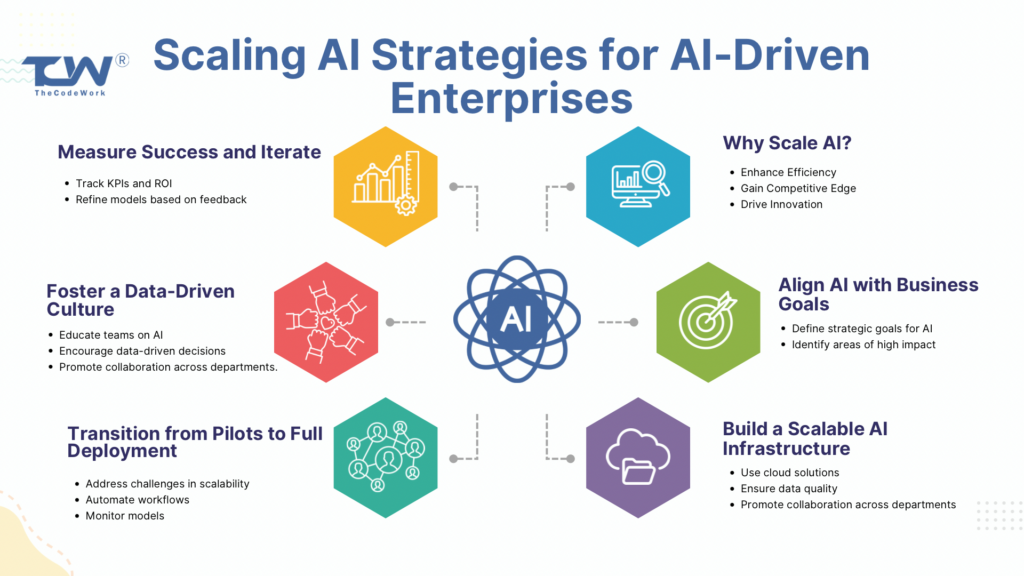
Scaling AI strategies is quite more than just an upgrade! With AI becoming more accessible and impactful, modern enterprises scaling its potential are transforming processes and generating new revenue streams. Afterall, it is a pivotal shift driving towards unprecedented operational efficiency, competitive edge and increased innovations.
Book a FREE consultation call to explore AI opportunities for your business.
Defining an AI Strategy Aligned with Business Goals
It goes without saying that drawing an AI strategy requires more than just technical expertise – Rather, it highly requires a clear alignment with your business objectives.
- Identify high-impact areas for AI: Primarily focus on areas where AI delivers great values like, supply chain optimization, customer services and product development.
- Maximize ROI: Secondly, prioritize the projects aligning with your strategic goals to ensure relevant ROI on AI investments.
- Ensure Data Quality and Accessibility: Most importantly, dedicate yourself to improving data quality and ensure accessibility across your business domains.
Building a Scalable AI Infrastructure
Now, to provide necessary support on AI scalability, its important to focus on building robust infrastructures and processes. Likewise, it includes:
- Cloud solutions: Utilize scalable cloud platforms to manage large datasets and support AI applications.
- Data storage: Then, ensure reliability and secure data storage to maintain data integrity and accessibility.
- MLOps: Implement Machine Learning Operations frameworks for seamless deployment, monitoring, and maintenance of AI models.
- Data quality and governance: Moreover, invest in data governance and cleansing protocols to ensure accurate, unbiased AI results at scale.
Moving from Pilot Projects to Full-Scale AI Deployment
Undoubtedly, its important to address certain challenges tactfully while scaling AI strategies to ensure smooth deployment. Therefore, some of the strategies would include:
- Implement automation: Automate repetitive tasks in order to streamline your scalability and improve overall efficiency.
- Establish model monitoring: Continuously, monitor your model performances to ensure that AI systems remain accurate and relevant over time.
- Standardize processes: Create standard procedures and workflows for AI deployment across departments, promoting consistency and reducing any friction.
Driving Organisational and Cultural Change
Above all, these sorts of transformations are not just a tech-oriented milestone only but a cultural one too! Hence, its equally important to foster an environment that supports AI adoption and encourages collaboration.
- Train teams on AI integration: Equip your teams with skills to use AI in their day-to-day tasks.
- Build trust in AI tools: Promote transparency around AI tools and processes to increase user confidence.
- Encourage collaboration: Additionally, facilitate cross-departmental collaboration to support AI integration.
Measuring AI Success and Iterating
Finally, to measure the success rate of your AI scalability efforts and drive continuous improvements – Consider, setting clear metrics and implement a structured process for regular evaluation, like:
- Define key performance metrics: Always, track essential indicators like model accuracy, speed, and business impact to assess the overall effectiveness.
- Regularly evaluate models: Also, conduct regular assessments to keep your AI models aligned with changing business goals.
Leveraging Specialized AI for Customer Experience
As enterprises scale their AI strategies, integrating domain-specific platforms can significantly accelerate the transition from pilot to production. For instance, Parloa offers an AI-driven platform tailored for customer service, enabling businesses to automate complex interactions via natural-sounding voice and text.
By incorporating such specialized tools into a scalable AI infrastructure, organizations can streamline operations and improve customer loyalty without the overhead of building bespoke models from scratch. This focus on high-impact areas like customer service ensures that AI investments deliver tangible ROI while freeing up human talent for more strategic initiatives.
FAQs
Q1. What is the best and fastest way to transition from AI pilots to full-scale deployment?
Ans: Primarily, focus on automation, model monitoring, and standardized deployment frameworks to ensure that AI initiatives are seamlessly scalable.
Q2. What is a “Tech sandwich,” and why is it relevant for scalable AI?
Ans- A “Tech sandwich” approach integrates centralized data management with decentralized AI inputs from various business departments. Consequently, this setup allows extensive scalability while ensuring AI’s potential to work collaboratively across different units.