
Causes of Shortage of Raw Materials in the Manufacturing Industry

A production order can be ready in every respect except one: a critical component that will arrive months after the promised delivery date.
On 20 November 2026, The New Indian Express reported: “Chip shortage, rising costs squeeze India’s EMS industry.” The report describes tightening component supply and pressure on India’s electronics manufacturing services industry.
The underlying Kaynes Technology investor presentation, filed on 15 November 2026, lists lead times of 26–52 weeks for microcontrollers and power devices, with peak SKUs highlighted. It identifies competition for capacity from AI and data-centre demand, alongside geopolitical disruption, as factors affecting supply. These are electronics-sector observations, not lead times for every manufacturing input.
For other manufacturers, the practical lesson is to examine how quickly a supplier delay reaches the production plan. If a critical material will arrive late, which customer orders are affected? How much usable stock remains? Is an approved substitute available?
External disruption and internal planning gaps need different responses. A factory cannot remove a global component shortage, but it can avoid planning against outdated delivery dates, incorrect BOMs or stock that is still awaiting quality approval.
That is why understanding the causes of shortage of raw materials requires looking beyond the supplier. A unit can hold plenty of inventory overall and still stop a production order for one missing item. The cost can include emergency buying, expedited freight, overtime, rescheduling and missed delivery commitments.
This guide examines seven common operational causes of material shortages and the controls manufacturers can use to identify risk earlier without simply buying more stock across the board.
The seven most common causes of raw material shortages
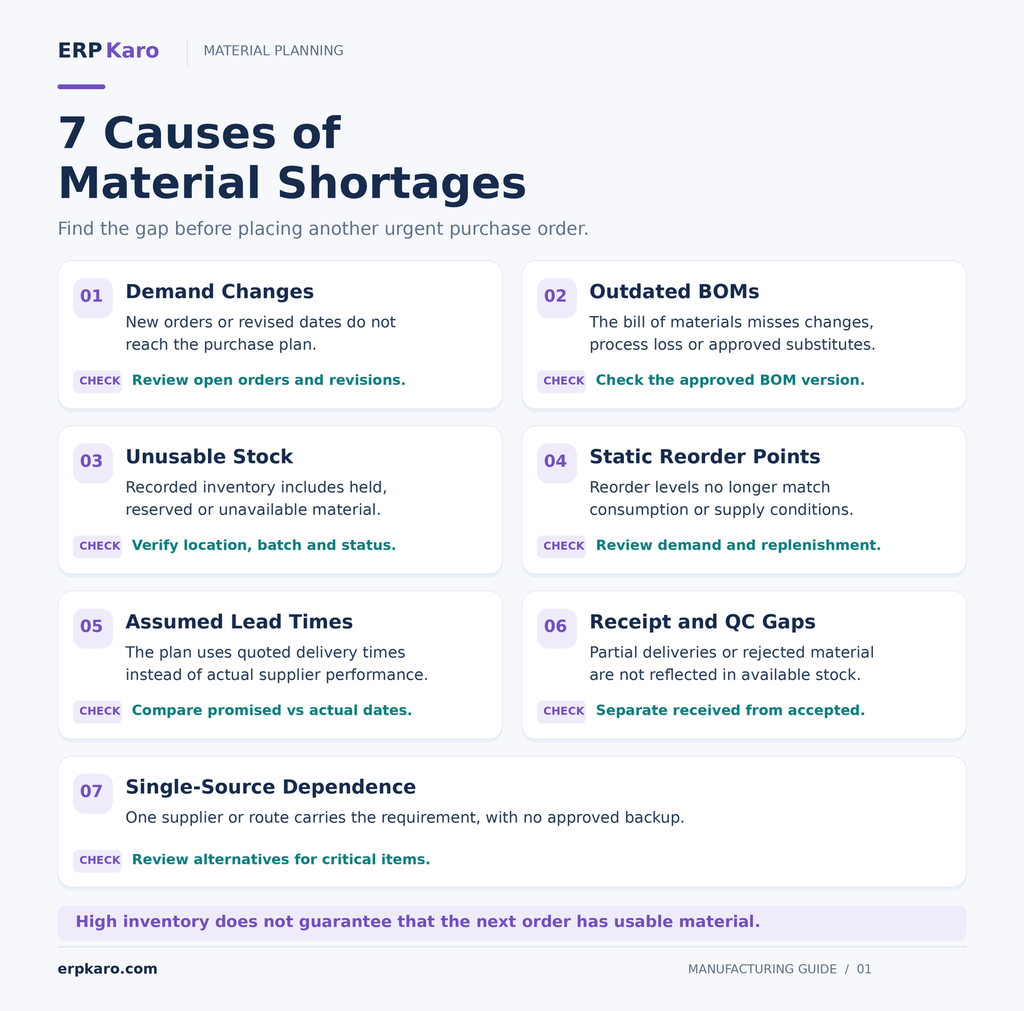
1. Demand changes do not reach procurement soon enough
Sales may accept a new order, revise a delivery date or increase quantity without the change being reflected in the material plan. Procurement continues buying against yesterday’s requirement, while production discovers the gap only when the order is due.
What to check: Compare every open sales order and forecast change against the current purchase plan. Decide who must approve and communicate any change that affects material requirement.
2. The BOM is incorrect, outdated or not tied to the production order
A bill of materials should state what is actually required to make the product. If the BOM uses an old component, ignores process loss, or does not reflect a recently approved substitute, the planned requirement will be wrong even if the stock record is perfect.
This is especially common when engineering changes are shared through email or WhatsApp but the planning file is not updated. Treat BOM version approval as a production control, not only an engineering task.
What to check: For the next five planned orders, compare the BOM in the system or planning sheet with the version used on the shop floor. Review material allowance, expected scrap and substitute rules.
3. Stock records show quantity, not usable quantity
“On-hand stock” is not always available stock. Material may be at another location, reserved for another order, under quality inspection, rejected, damaged or already issued to WIP. Planning against the gross stock figure creates a false sense of coverage.
The material calculation should distinguish between physical stock and stock that can legitimately be used for the order. ERPKaro’s order-to-dispatch walkthrough shows this principle: requirements are checked against eligible stock, while QC and batch status remain visible.
What to check: When a shortage is reported, trace the item by location, batch and status before placing an emergency order.
4. Reorder points are set by habit
“We order this material when it reaches 500 kg” may once have worked. It fails when demand, lead time, minimum order quantity or production mix changes. A single static reorder level also does not account for confirmed future orders.
A practical reorder decision needs at least three inputs: expected consumption during lead time, a realistic safety margin and already-committed demand. If these inputs are not current, the reorder point becomes a ritual rather than a control.
What to check: For critical materials, review average consumption, supplier lead time, minimum order quantity and the next scheduled production requirement monthly or after any material disruption.
5. Supplier lead times are assumed instead of measured
A supplier may quote seven days, but actual delivery can vary because of capacity constraints, transport delays, import dependencies or partial dispatches. If the plan keeps using seven days after several 12-day deliveries, the shortage is built into the schedule.
The chip-supply example illustrates why lead times need regular review. When a supplier revises a delivery date, update both the expected receipt and the production orders that depend on it. An open PO is not proof that material will arrive before the job starts.
The RBI identifies supplier delivery time, backlog of work and stock purchases as useful indicators of supply-chain pressure in India. Its supply-chain pressure analysis is a useful reminder that lead-time risk is external as well as internal.
What to check: Track promised date, actual receipt date and actual quantity for each supplier and critical material. Use the median or a conservative recent lead time for planning, not the best-case number.
6. Quality failures and partial receipts are not reflected immediately
The PO may say 1,000 units were received, while only 700 have passed incoming QC. Or a truck may have delivered a partial quantity while the team assumes the full PO is available. If the receiving process does not record actual receipt, inspection and acceptance separately, production can plan with material it cannot use.
What to check: Ensure stores records the actual inward quantity, QC status and rejected or returned quantity on the day of receipt. Notify procurement when the accepted quantity cannot cover the next scheduled job.
7. One supplier or one route carries too much risk
Single sourcing may be commercially sensible for specialised material, but it requires a deliberate contingency plan. A supplier capacity issue, logistics disruption, regulatory delay or price shock then has no alternative route.
For eligible Indian MSMEs, the NSIC Raw Material Assistance Scheme is one possible procurement support route. It covers indigenous and imported material procurement, and the official guidance notes support for credit-based procurement and certain bulk-supply arrangements.
What to check: Identify materials with a single approved supplier, long import lead time or no viable substitute. Give these items a separate risk review rather than applying one buffer-stock rule to all materials.
Diagnose the shortage before buying more
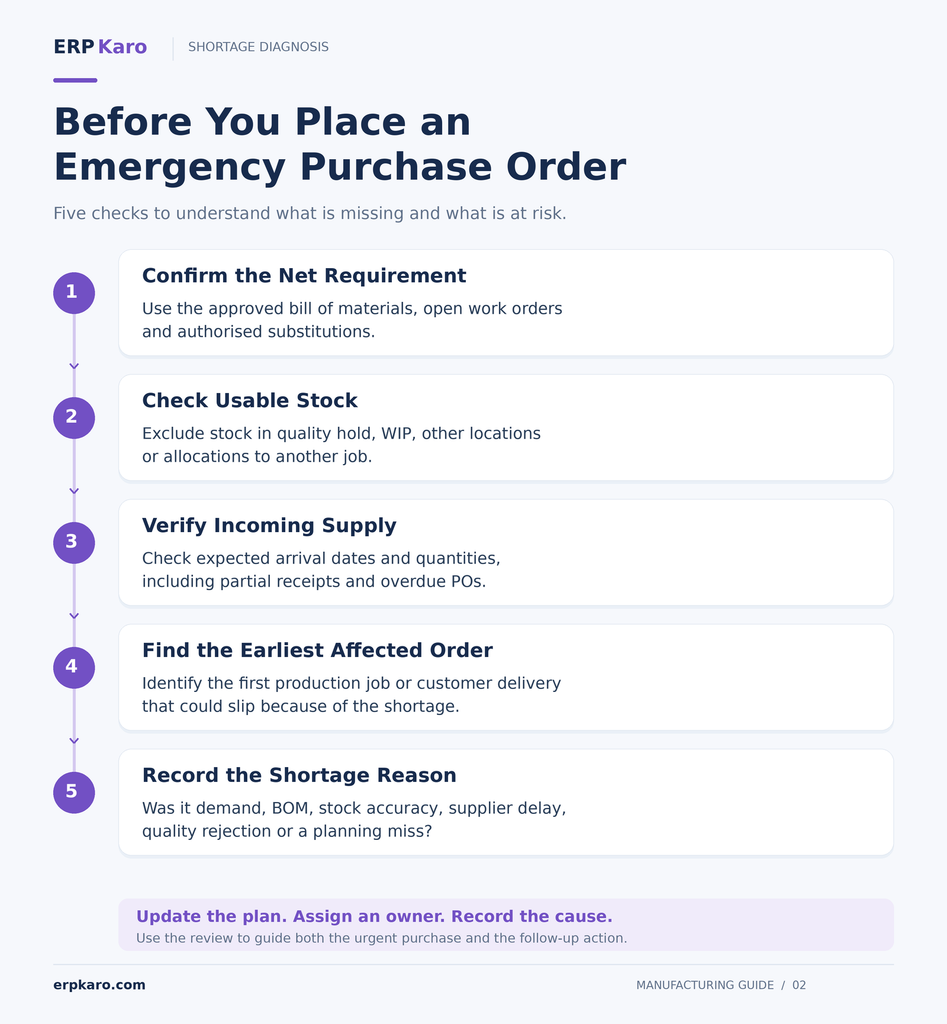
When a critical item is short, avoid treating an urgent purchase as the entire fix. Use this five-step review first:
- 1. Confirm the net requirement. What does the approved BOM require for the open work orders, after accounting for completed production and approved substitutions?
- 2. Confirm usable stock. Separate available stock from material in QC, WIP, quarantine, another warehouse or allocation.
- 3. Check incoming supply. Review open POs against actual expected receipt dates and quantities, not only PO dates.
- 4. Find the earliest affected order. Identify which customer commitment or production order will slip first.
- 5. Record the reason code. Was it demand change, BOM error, inventory accuracy, supplier delay, quality rejection or a planning miss?
How to prevent material shortages without carrying excess inventory?
The goal is not maximum stock. It is reliable material availability for committed production.
Connect demand to material planning
Every confirmed order, approved forecast and production plan should flow into one requirement view. For make-to-order operations, this typically starts from the sales order and BOM. For make-to-stock operations, it may begin with the production plan and replenishment policy. In both cases, procurement needs early visibility of what will be needed and when.
Set different controls for different material risks
Do not manage every item the same way. Use a more cautious control for long-lead, imported, sole-source and production-stopping materials. Use lighter controls for local, low-value and easily substitutable items. This prevents safety stock from becoming a blanket response.
Make inventory accuracy a daily operating discipline
Cycle counts, timely GRNs, clear location labels, batch status and WIP issue records are not back-office chores. They determine whether the production plan is credible. A shortage dashboard built on inaccurate transactions only gives a faster view of a wrong answer.
Review exceptions in a short cross-functional meeting
A 15-minute weekly review between planning, stores and procurement can cover overdue POs, materials below cover, quality holds, upcoming high-risk orders and changes in customer commitments. The outcome should be named actions, not a longer report.
A worked example: why stock can look high while production stops
Consider a hypothetical machine-component manufacturer with 800 bearings recorded in stock. Its next production order requires 600 bearings, so the planner considers the order covered.
But on review, 250 are at another plant, 150 are awaiting inspection and 100 have already been issued to a different job. Only 300 are eligible for the new order. The real shortage is 300, not zero.
If the material requirement had been netted against eligible stock and the incoming PO status checked early, procurement could have raised a request before the production date. The lesson is simple: total inventory is not the same as material readiness.
What Should a Connected System Make Visible?
The operational question is not merely “What is in stock?” It is “Can we start and complete the next planned order with acceptable material, in the right location, on time?”
That requires visibility across:
- Open sales and production orders
- BOM demand and approved substitutes
- Available, reserved, WIP, QC-hold and rejected stock
- Purchase orders, partial receipts and supplier delays
- Lead-time trends and shortage reasons
TheCodeWork’s article on why supply-chain digitisation still fails explains why separate digital tools still create stockouts when the underlying data does not connect.
FAQ
1. What is the most common reason for raw material shortages?
There is rarely one universal reason. For individual manufacturers, the most common causes are usually poor demand visibility, inaccurate available-stock records, outdated BOMs and supplier lead times that are not reflected in the plan.
2. Should we increase safety stock to prevent material shortages?
Only for items where the risk justifies it. Increasing stock across the board can lock up cash while leaving the actual critical item short. Base safety stock on demand variability, replenishment lead time, supplier reliability and the cost of a line stoppage.
3. Can ERP software prevent all material shortages?
No. An ERP cannot remove supplier disruption or poor-quality receipts. It can help teams see connected demand, usable stock, open supply and upcoming risk earlier, provided transactions, BOMs and lead-time data are kept current.
Move from emergency buying to earlier decisions
ERPKaro, developed by TheCodeWork, connects BOM demand, eligible inventory, purchase requests, POs and actual receipts so procurement can act on a real shortage rather than yesterday’s spreadsheet. See how ERPKaro procurement management supports material planning and inbound control.