What Is an ERP Readiness Assessment? A Practical Guide for Manufacturers
An ERP readiness assessment is a structured review of whether a business is prepared to select, implement and actually use an ERP system. For a manufacturer, it looks beyond software features: it tests the condition of production processes, master data, inventory records, decision ownership, integrations and team preparedness.
This matters because an ERP can connect purchasing, stores, production, quality and dispatch, but it cannot make an unclear bill of materials accurate or decide who is allowed to approve a material substitution. Those decisions must be made before configuration begins.
For a growing Indian manufacturer, the assessment is not a reason to delay forever. It is a way to identify the few gaps that could otherwise turn a straightforward rollout into rework, spreadsheet fallbacks and low adoption.
What an ERP readiness assessment is, and is not?
An assessment answers two separate questions:
- 1. Do we need an ERP now? This examines whether coordination problems, poor stock visibility, delayed reporting or rising operational complexity justify a shared operational system.
- 2. Can we implement it reliably? This examines whether the business has enough clarity, ownership and usable data to make the first phase successful.
It is not a vendor scorecard or a technical audit alone. Vendor selection comes after the manufacturer understands its own workflow and priorities. Nor is readiness a pass-or-fail score. A business may be ready to start with inventory, purchase and production order control while postponing a complex integration or secondary location to a later phase.
The six areas a manufacturing readiness assessment should cover
The most useful assessment traces a real customer order from enquiry or sales order to dispatch. It should cover the six areas below.
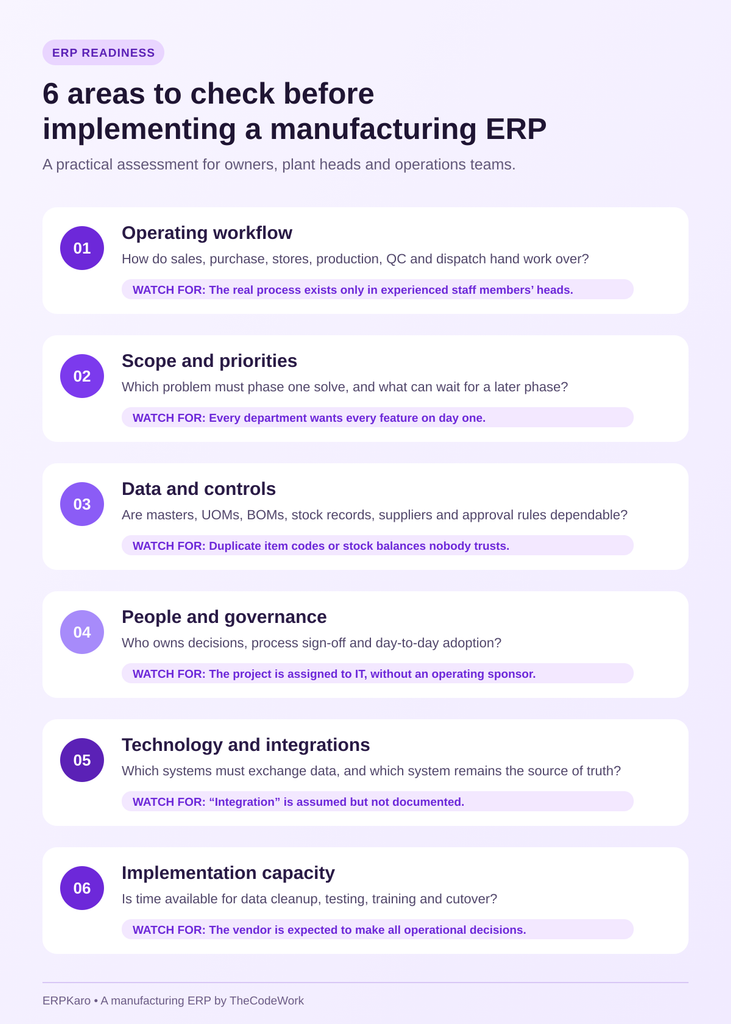
This is consistent with established implementation guidance. Microsoft’s go-live readiness guidance calls for completed and signed-off testing, a data-migration plan, user training, correct roles and a support plan. Infor’s ERP implementation checklist similarly puts governance, change readiness and data readiness alongside software selection.
Start with one real order, not a feature list
Feature lists often create false confidence. A manufacturer may see “BOM,” “inventory,” “purchase order” and “production order” in a product brochure, yet still not know whether the system fits its actual exceptions.
Instead, select one recently completed order and map what really happened:
- 1. What triggered production: a sales order, forecast, reorder level or project plan?
- 2. Which materials did the BOM require, and were approved substitutes used?
- 3. Where was stock checked: a warehouse location, an Excel sheet, a register or a person’s memory?
- 4. Who released the work order, recorded material issue and confirmed output or scrap?
- 5. What happened if material was short, quality failed or the customer requested a partial dispatch?
- 6. Which data must reach accounts, a logistics partner, a customer portal or another application?
This creates a practical scope statement: for example, “phase one must plan material against confirmed sales orders, show stock by location, release production orders and record finished-goods dispatch.” It is much stronger than “we need manufacturing ERP.”
Check data readiness before migration becomes a crisis
Data cleanup does not mean achieving perfection in every old file. It means agreeing on the records needed to run the first live workflows. Review these early:
Item, unit and location masters
Each active raw material, WIP item and finished good needs an unambiguous code, description, unit of measure and applicable storage location. Where purchase, stock and production units differ, document the conversion and who maintains it.
BOMs, routes and quality points
Confirm the BOM version used on the shop floor, expected yield or scrap assumptions, work centres if applicable, and the points where QC can hold or release material. Do not migrate obsolete recipes or undocumented variants simply because they exist in a spreadsheet.
Opening inventory and open transactions
Agree on a stock-count date, the basis for stock valuation, batches or lots where needed, and which open purchase orders, sales orders and work orders will move into the new system. Reconcile these figures before go-live, rather than discovering differences during dispatch.
Supplier and customer information
Remove duplicates and confirm payment terms, lead times, addresses, GST details and approved materials. Supplier lead times are particularly important when the ERP will be used to assess material availability.
Assess readiness for change, not only readiness for software
ERP introduces new discipline. A store entry delayed by a day can distort material availability. An unrecorded rejection can make usable stock appear higher than it is. A production confirmation entered after dispatch weakens every management report that follows.
That makes role-based training and management sponsorship operational requirements, not HR formalities. Before selecting a vendor, name:
- – an executive sponsor who resolves cross-functional decisions;
- – a process owner for each workflow, such as purchase-to-stock or plan-to-produce;
- – one person authorised to approve master-data changes and exceptions;
- – department champions who can test the system using real transactions; and
- – a short support route for the first weeks after go-live.
Microsoft recommends that readiness reviews identify risks, assign mitigation actions and inform a go/no-go decision, rather than being left to the last few days before launch. That principle works equally well for a smaller factory: track open gaps, their owner and their deadline.
A simple readiness scorecard for leadership review
Use a three-colour rating for every area. The score is less important than the evidence behind it.
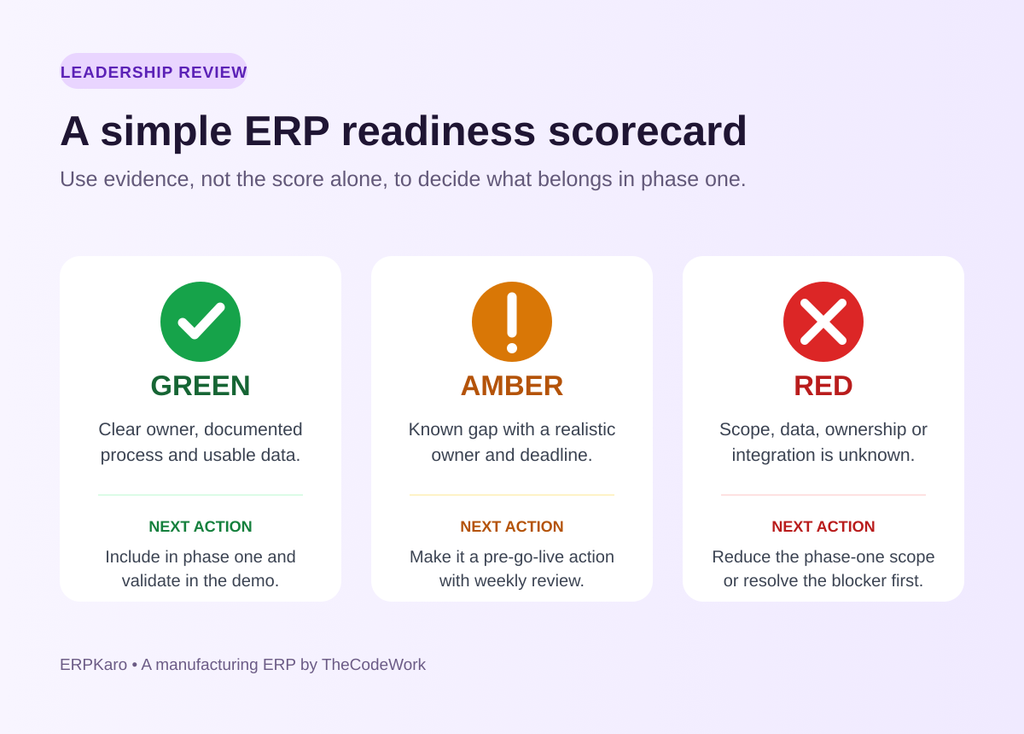
For example, a fabrication unit may be green on item masters and purchase approvals, amber on BOM version control, and red on actual labour capture. It can still begin an ERP programme, but it should not promise labour-cost reporting at go-live until the capture process is agreed and tested.
Questions to ask an ERP vendor after the assessment
Once the internal picture is clear, ask each shortlisted vendor to show the following against your real order:
- 1. how it checks material availability from the BOM and current stock;
- 2. how it handles a partial receipt, QC hold, rejected batch or approved substitution;
- 3. how a production order moves from release to WIP, output and dispatch;
- 4. which fields, approvals and reports are configured versus custom-built;
- 5. what data templates, migration checks, testing and training are included; and
- 6. how the system will work alongside the accounting software you intend to keep.
This approach avoids a common implementation failure: buying a system based on a polished generic demo, then discovering that a critical exception was never discussed.
For a broader evaluation framework, see ERPKaro’s manufacturing ERP buying guides. TheCodeWork has also explored why digital programmes stall when data and processes remain disconnected in Why Supply Chain Digitization Still Fails Despite Technology Investments.
FAQ
When should a manufacturer conduct an ERP readiness assessment?
Conduct it before shortlisting vendors or committing to a project plan. It can also be repeated before go-live, but the early assessment is where it prevents unsuitable scope and unplanned data work.
How long does an ERP readiness assessment take?
For a single-site MSME manufacturer, an initial assessment can be completed in a few focused working sessions if the right operations, stores, procurement and finance stakeholders are available. More plants, warehouses or integrations require deeper review.
Does a low readiness score mean we should not buy an ERP?
No. It means the rollout should be sequenced. Fix the high-risk gaps, define a smaller first phase and decide what needs to be standardised before go-live.
Make the assessment useful
An ERP readiness assessment should leave leadership with a phased scope, a list of data and process actions, named owners and a better vendor evaluation brief. That is what turns an ERP project from a software purchase into an operational improvement programme.
ERPKaro, developed by TheCodeWork, offers a free ERP readiness assessment for Indian manufacturers. It covers operational workflow, complexity, process standardisation, reporting, implementation readiness, and current pain points.