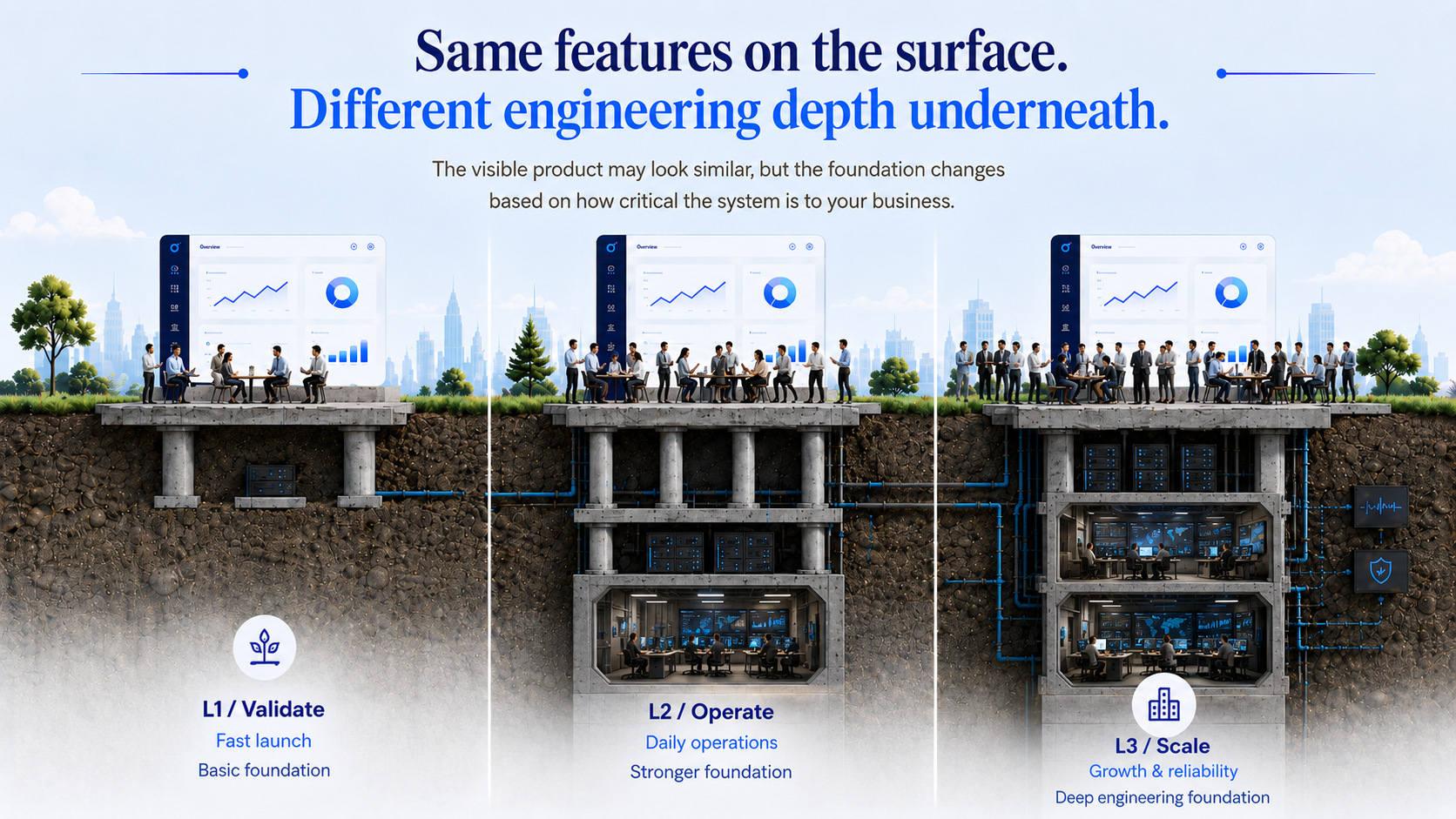
Which level is right for you?
Find the row that sounds most like your project today. The recommended level is where most teams in that situation land.
I am testing an idea
L1 ValidateI have internal users only
L1 or L2My staff will use this daily
L2 OperateCustomers will use this daily
L2 OperatePayments, invoices, orders, or inventory are involved
L2 minimumHigh traffic, compliance, or partner integrations
L3 ScaleI cannot afford downtime or data mistakes
L3 ScaleHere's what each level delivers in detail ↓
L1 — Validate
Validate the idea
quickly.
“I need to test this idea without over-investing.”
Best when
- you are testing a new idea
- usage is low or controlled
- speed and cost matter more than operational maturity
What changes underneath
- faster delivery
- lean engineering setup
- basic logs and manual checks
- limited automation
- suitable for MVPs and pilots
Business impact: Lower upfront cost, higher future upgrade possibility.
Not recommended for systems where customers, payments, inventory, or daily operations depend on it.
L2 — Operate
Run daily operations
reliably.
“My team or customers will use this daily, so it must be reliable.”
Best when
- customers or staff depend on it every day
- failures can disrupt daily work
- you need better visibility and support
What changes underneath
- background processing for emails, reports, invoices
- error tracking and monitoring
- staging before production
- key automated tests
- better logs and activity tracking
- safer deployment process
Business impact: Balanced cost, reliability, and maintainability.
This is the plan most serious businesses choose.
L3 — Scale
Scale with
confidence.
“This is business-critical and must handle growth, integrations, and failures.”
Best for businesses where system failure directly affects revenue, reputation, or operations.
Best when
- the system is business-critical
- traffic or data volume is expected to grow
- payments, integrations, or sensitive data are involved
- downtime or data issues are expensive
What changes underneath
- managed infrastructure components
- advanced monitoring and alerts
- stronger security controls
- scalable background processing
- deeper testing and performance planning
- rollback and recovery strategy
Business impact: Higher upfront planning, lower risk at scale.
Same feature list. Different engineering depth.
A validation build, a daily operations system, and a scale-ready platform are not engineered the same way. We help you choose the right build approach based on your current stage, risk level, and growth plans.