Secure, scalable product engineering
Growth can happen overnight.
Your architecture should be ready before it does.
We engineer systems that absorb sudden demand, isolate failures, protect sensitive operations and remain controllable as users, integrations, automation and AI expand.
Incoming requests
node
node
node
Steady demand. Capacity held in reserve. Capacity expands. Boundaries remain. One node drops. The rest keep serving. Automation loses access. The system stays up.
- Built to expand Scale without disruption
- Designed to isolate Keep failures contained
- Engineered for control Maintain security and visibility
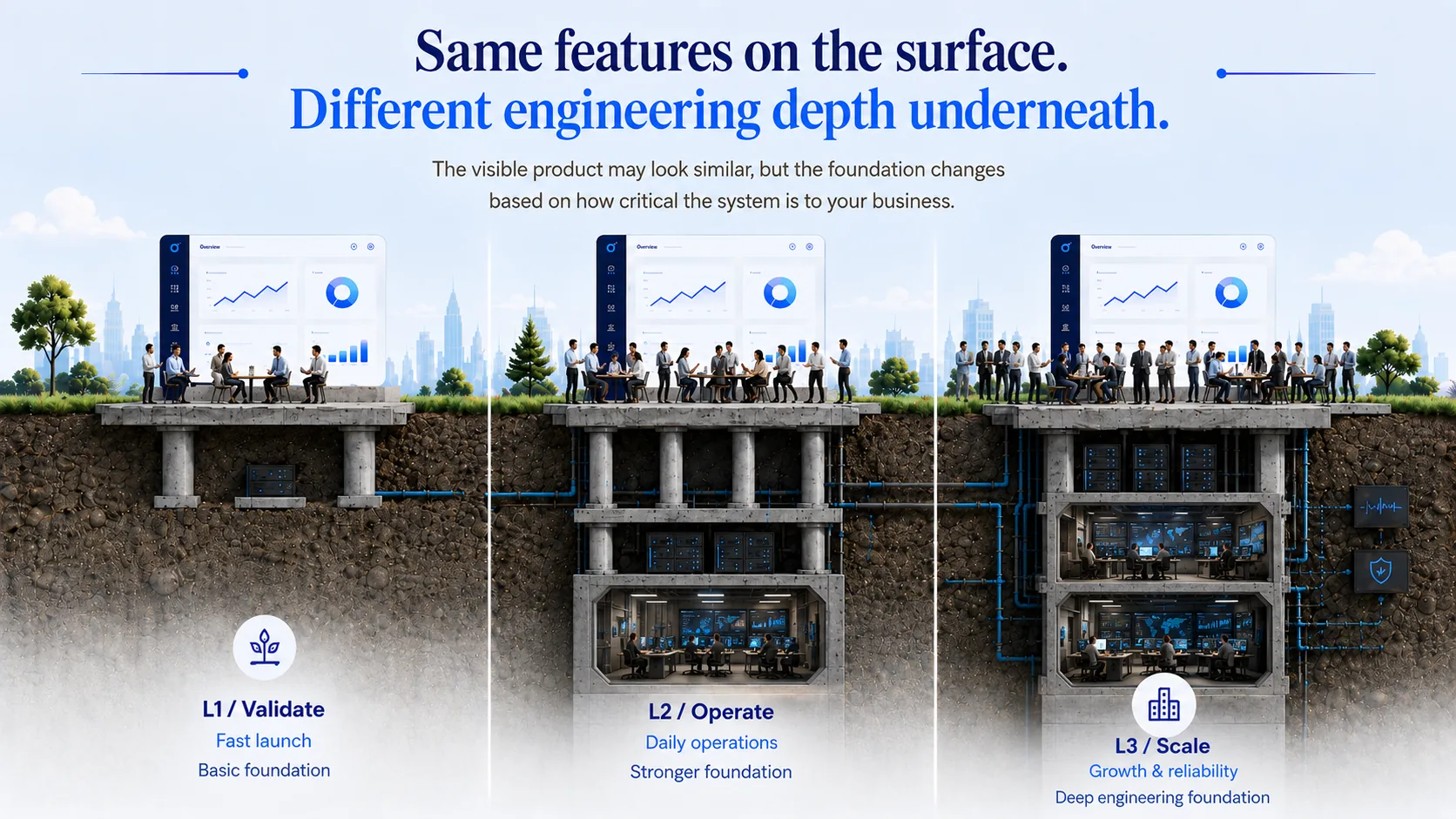
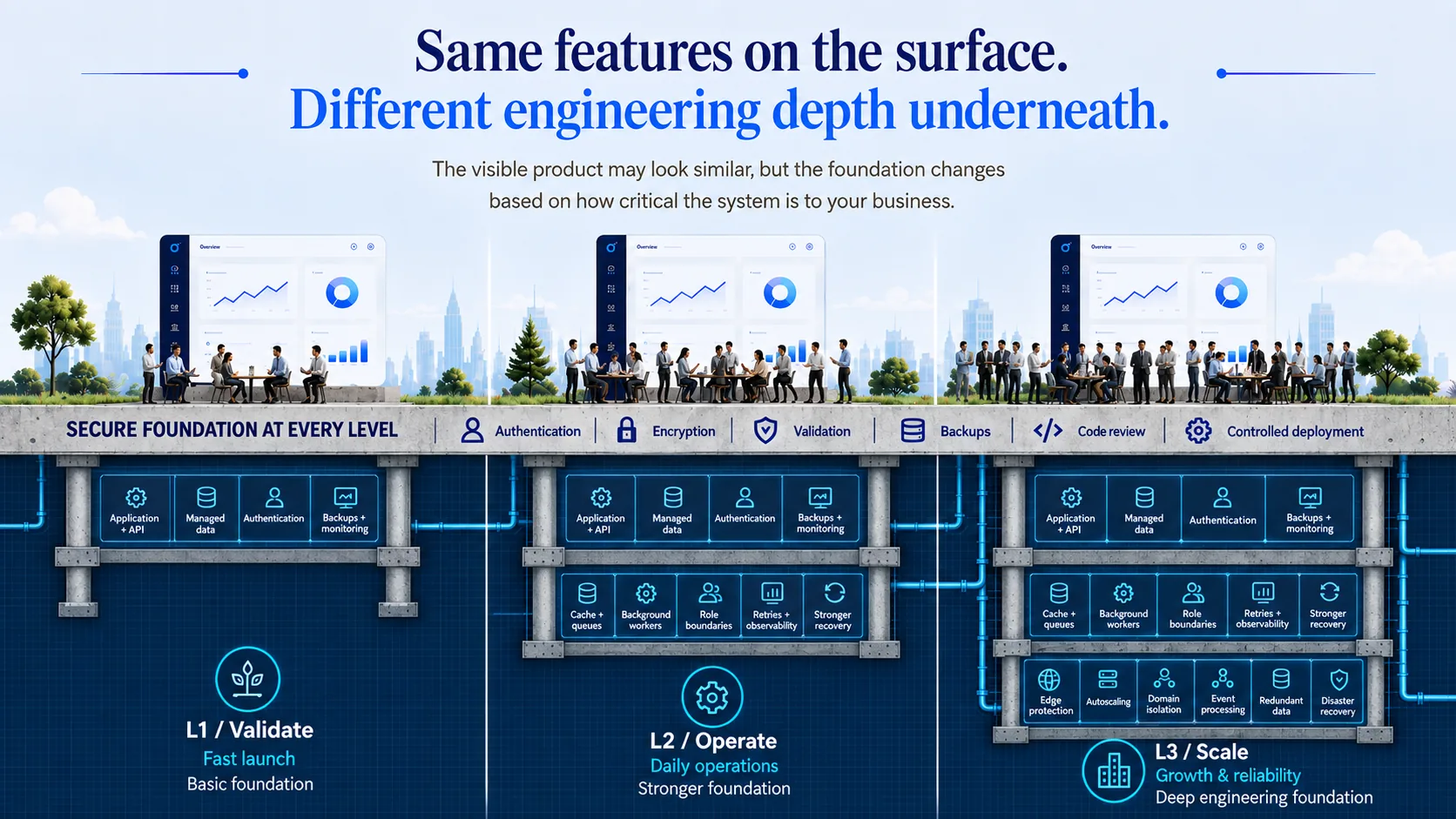
What your customers and your team see: the same product at every level. What we build underneath: the parts each level adds, on the foundation every level shares.
Which level is right for you?
Find the row that sounds most like your project today. The recommended level is where most teams in that situation land.
I am testing an idea
L1 ValidateI have internal users only
L1 or L2My staff will use this daily
L2 OperateCustomers will use this daily
L2 OperatePayments, invoices, orders, or inventory are involved
L2 minimumHigh traffic, compliance, or partner integrations
L3 ScaleI cannot afford downtime or data mistakes
L3 ScaleHere's what each level delivers in detail ↓
L1 — Validate
Validate the idea
quickly.
“I need to test this idea without over-investing.”
Best when
- you are testing a new idea
- usage is low or controlled
- speed and cost matter more than operational maturity
What changes underneath
- faster delivery
- lean engineering setup
- basic logs and manual checks
- limited automation
- suitable for MVPs and pilots
Business impact: Lower upfront cost, higher future upgrade possibility.
Not recommended for systems where customers, payments, inventory, or daily operations depend on it.
L2 — Operate
Run daily operations
reliably.
“My team or customers will use this daily, so it must be reliable.”
Best when
- customers or staff depend on it every day
- failures can disrupt daily work
- you need better visibility and support
What changes underneath
- background processing for emails, reports, invoices
- error tracking and monitoring
- staging before production
- key automated tests
- better logs and activity tracking
- safer deployment process
Business impact: Balanced cost, reliability, and maintainability.
This is the plan most serious businesses choose.
L3 — Scale
Scale with
confidence.
“This is business-critical and must handle growth, integrations, and failures.”
Best for businesses where system failure directly affects revenue, reputation, or operations.
Best when
- the system is business-critical
- traffic or data volume is expected to grow
- payments, integrations, or sensitive data are involved
- downtime or data issues are expensive
What changes underneath
- managed infrastructure components
- advanced monitoring and alerts
- stronger security controls
- scalable background processing
- deeper testing and performance planning
- rollback and recovery strategy
Business impact: Higher upfront planning, lower risk at scale.
Same feature list. Different engineering depth.
A validation build, a daily operations system, and a scale-ready platform are not engineered the same way. We help you choose the right build approach based on your current stage, risk level, and growth plans.
Industries We've Engineered Systems For
Over the past 8 years, we've built custom software systems across diverse industries — each shaped by unique operational challenges, compliance needs, and scale requirements. While our engineering approach remains structured and architecture-first, every solution is tailored to the realities of its domain.
Health & Compliance Systems
Patient platforms, FHIR integrations, workflow automation, secure data systems.
Logistics & Operations Platforms
Order management, fleet tracking, warehouse sync, multi-location coordination.
SaaS & Business Productivity
Admin dashboards, subscription systems, internal tools, performance tracking.
Commerce & Marketplaces
Multi-vendor platforms, payments, catalog management, transaction engines.
FinTech & Payment Systems
Billing engines, recurring subscriptions, reconciliation, compliance flows.
HR & Workforce Platforms
Performance management, employee systems, reporting and workflow automation.
Technology Stack, Chosen Per Architecture
We don't start with tools — we start with system design. Our technology choices are guided by scalability, performance, integration complexity, and long-term maintainability. The stack follows the architecture — not trends.
Backend & System Logic
Node.js, Python, PHP, Java. Microservices, APIs, workflow engines.
Frontend & Experience Layer
React, Vue, Next.js. Admin dashboards, portals, real-time interfaces.
Mobile Platforms
Flutter, React Native. Production-ready Android & iOS systems.
Infrastructure & Cloud
AWS, CI/CD pipelines, containerization. Scalable deployment and monitoring architecture.
Technology decisions are documented, justified, and aligned with long-term system ownership.
Build It Right. Build It Faster.
If you're planning a new platform, modernizing an existing system, or validating an idea — we can help you structure it properly before execution begins.
Our 30-minute strategy session focuses on clarity: scope, architecture direction, risks, and realistic timelines. No sales pitch. Just structured thinking from engineers who have delivered 150+ systems over 8 years.
Building for your own clients? We also work as the engineering team behind agencies, product companies and consultancies. See how we partner →
Before You Reach Out
Serious projects raise serious questions. Here's what clients typically ask before we begin.